Tata Elxsi’s Shunya Partnership Pushes India’s eVTOL Race Forward
Tata Elxsi and Sarla Aviation are working on Shunya, a six-seater eVTOL targeting its first flight within 18–24 months.
 Jishan Khan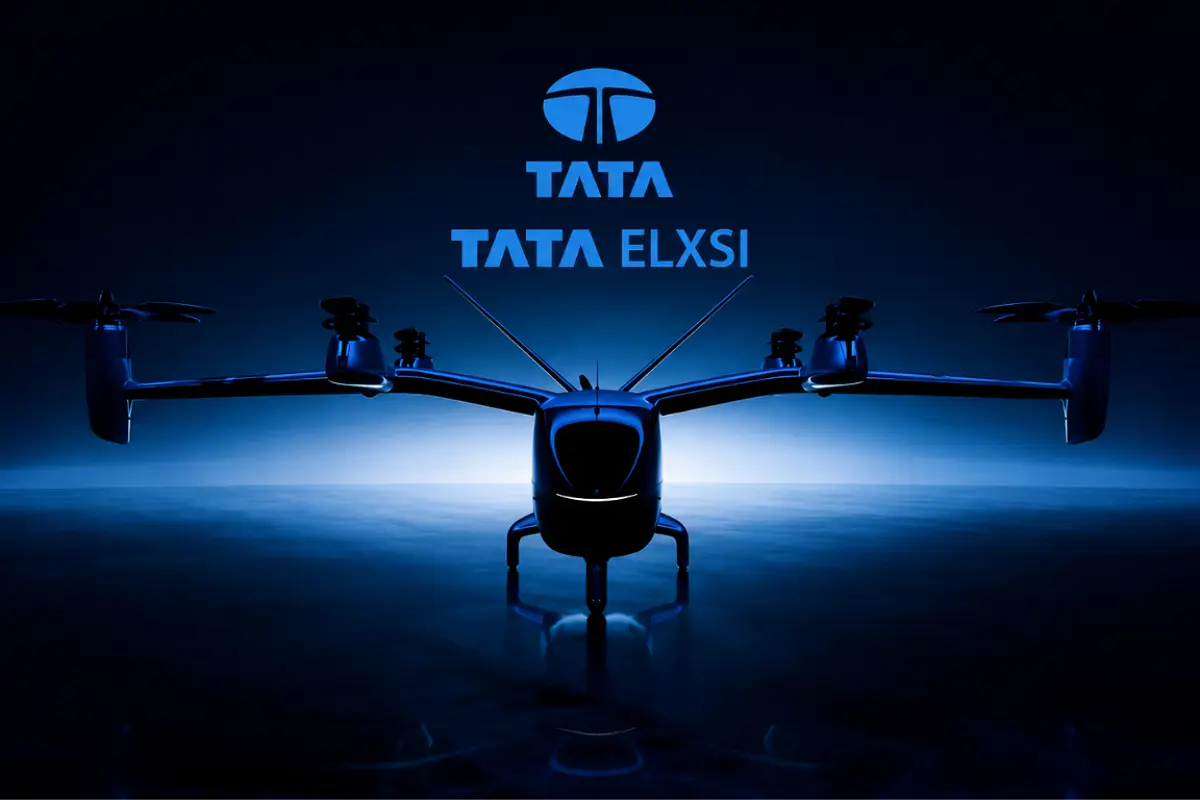
Tata Elxsi's Stock Jumped on an MoU With No Money Attached, That Tells You What the Market Actually Thinks India's eVTOL Race Is Worth
Tata Elxsi shares climbed on September 1, 2026, the day the company announced a Memorandum of Understanding with Bengaluru-based Sarla Aviation to support development of Shunya, a six-passenger-plus-pilot electric vertical takeoff and landing aircraft designed for a range exceeding 300 kilometres. No financial terms were disclosed. No funding commitment was announced. A listed engineering services company's stock moved on the strength of a partnership agreement alone, which says less about Shunya's commercial prospects today and more about how starved Indian markets currently are for a credible domestic aerospace story to price into anything.
What Tata Elxsi Is Actually Bringing to the Table
The division of labour in this MoU is precise and worth reading closely, because it reveals which parts of building a certifiable aircraft Sarla Aviation has decided it cannot do alone. Tata Elxsi will provide engineering support for avionics, flight-control systems, software integration, testing, verification and validation, and certification-related activities, with the scope potentially extending to sensor-fusion-based navigation software, industrial and structural design, and airworthiness testing. Sarla Aviation retains overall design leadership, development and type certification responsibility for the Shunya platform itself.
That split matters because it is almost the inverse of how a traditional aircraft manufacturer would structure an in-house programme. Tata Elxsi is not an aerospace manufacturer in the conventional sense, it is a design and technology services company whose core expertise sits in software engineering, digital systems and complex embedded engineering across sectors including automotive, healthcare and broadcast, alongside a genuine aerospace practice. Bringing in a partner with that specific profile, rather than a traditional aerostructures or propulsion manufacturer, signals that Sarla views flight-critical software, the systems that translate pilot input into control surface and rotor commands, manage power distribution across an electric propulsion system, and satisfy a regulator that the aircraft will behave predictably in every failure mode, as the harder and more consequential problem to solve correctly, ahead of the airframe itself.
Why the Configuration Choice Is the Quiet Technical Bet Underneath This Whole Story
Shunya's design combines vertical takeoff and landing capability with fixed-wing cruise efficiency, a hybrid or "compound" eVTOL architecture rather than a pure multicopter design. That distinction is not a minor engineering preference; it is the same fundamental design philosophy this feed covered when documenting Air New Zealand's conclusion, after 100 demonstration flights with Beta Technologies' pure-electric ALIA CX300, that battery energy density limits make small, single-mode electric aircraft commercially challenged on payload and range simultaneously. A vectored or transitioning-wing design that takes off vertically like a helicopter but cruises like a fixed-wing aircraft addresses exactly that constraint, vertical flight is energy-intensive and range-limiting, while fixed-wing cruise is dramatically more efficient per kilometre travelled. Getting more of a flight's total distance into efficient cruise mode, rather than hovering flight, is the single most important lever available to any eVTOL designer trying to stretch battery-electric range past the roughly 150-200 km ceiling that pure multicopter designs typically struggle to exceed.
Shunya's 300km-plus target range sits meaningfully above that ceiling, which only makes sense if the aircraft is genuinely optimised to spend most of its mission profile in efficient fixed-wing cruise rather than hover, precisely the architecture the MoU's own description confirms Sarla has chosen.
Why "18 to 24 Months to First Flight" Is the Easy Promise, Not the Hard One
Every party in this announcement has been careful to frame the timeline correctly: first flight is targeted within 18 to 24 months, "followed by certification activities", language that quietly acknowledges first flight and certification are entirely different milestones, separated by a gap that has proven far longer and far more difficult than any eVTOL developer initially expects. This feed's own coverage of Heart Aerospace's X1 demonstrator, the largest battery-electric aircraft ever flown, which completed its first flight in August 2026 after slipping more than a year past its original Q2 2025 target, offers a directly comparable cautionary data point. X1 was explicitly a technology demonstrator, not a certifiable aircraft, and Heart's actual commercial ES-30 is not expected to begin flight testing until 2028, with type certification targeted for 2031, a full decade-long gap between the company's founding ambitions and an aircraft actually carrying paying passengers.
Shunya's own path will almost certainly face the same asymmetry. Building a prototype that successfully lifts off, transitions to cruise, and lands again, even if achieved cleanly within the stated 18-24 month window, demonstrates the concept works. It does not demonstrate the aircraft can survive the failure-mode analysis, redundancy requirements, and exhaustive testing regime that India's Directorate General of Civil Aviation, or any credible international regulator, will require before certifying a new aircraft category carrying paying passengers with no direct historical precedent to certify against. Every eVTOL programme globally, Joby, Archer, Beta, Heart, has found certification, not first flight, to be the multi-year bottleneck that separates an impressive demonstration from an operating commercial aircraft.
Where Shunya Sits Inside India's Broader Advanced Air Mobility Push
This announcement lands directly alongside this feed's recent coverage of South Korea's government-backed hybrid VTOL programme and its parallel K-UAM commercial air taxi partnerships with Beta Technologies, Skyports and UI Helicopter, a useful comparison because it highlights two different national strategies for building sovereign advanced air mobility capability. South Korea is running a dual-track approach: importing proven foreign technology for near-term commercial deployment by 2029, while simultaneously funding a slower, fully domestic hybrid VTOL programme targeting prototype completion only by 2032. India's Shunya programme, by contrast, is being built through a private partnership between an Indian aerospace-adjacent technology company and an Indian advanced air mobility startup, with no visible foreign aircraft import track running in parallel as a near-term commercial hedge.
That makes India's bet more concentrated and, in some respects, higher-risk, there is no interim K-UAM-style imported-aircraft commercial launch cushioning the timeline if Shunya's own certification path runs long, the pattern this feed has now documented as close to universal across every eVTOL programme covered this year. It also makes a successful outcome more valuable strategically: an Indian-designed, Indian-certified eVTOL reaching commercial service would represent a genuinely indigenous aerospace capability in a category where China, the US and Europe currently dominate almost entirely, and where India's own aviation growth story, 470-aircraft Air India orders, IndiGo's fleet pause and finance-lease pivot, Riyadh Air and flynas's parallel widebody ordering this feed has tracked extensively across the Gulf, has so far been built almost entirely on foreign-manufactured aircraft.
Air Ambulance and Logistics Are the Realistic Near-Term Use Cases, Not Urban Passenger Transport
Sarla Aviation's own public positioning around Shunya emphasises urban air mobility, but the more commercially plausible early applications for a six-passenger, 300km-range compound eVTOL in the Indian context likely sit closer to air ambulance services connecting underserved rural areas to tertiary hospitals, time-sensitive logistics for pharmaceutical or high-value cargo, and potentially defence or paramilitary applications requiring runway-independent operations in terrain where conventional aircraft infrastructure is limited or absent. Each of those use cases carries a materially lower regulatory bar than certifying an aircraft for routine urban passenger transport over densely populated areas, a distinction this feed has seen play out clearly in South Korea's own K-UAM sequencing, where military and cargo eVTOL applications are being pursued as a certification and operational proving ground ahead of the more demanding urban passenger service target.
What Actually Determines Whether This Becomes India's First Real eVTOL Story
Tata Elxsi's stock reaction to a term-free MoU is the clearest signal of how early-stage this entire programme remains — markets do not typically reward companies meaningfully for signing partnership agreements unless the underlying opportunity is being priced almost entirely on narrative and optionality rather than committed capital or near-term revenue. That is not a criticism specific to Shunya; it is simply an accurate description of where every eVTOL programme globally sits at this stage of development, Heart Aerospace and Beta Technologies included, despite those companies carrying multi-billion-dollar order books from major airlines that Sarla Aviation, as an earlier-stage Indian startup, has not yet assembled.
The genuine test of this partnership will not arrive in 18 to 24 months when Shunya's prototype, if the timeline holds, lifts off for the first time. It will arrive in the years immediately after that first flight, when Sarla Aviation and Tata Elxsi discover, as Heart Aerospace, Joby, Archer and every other eVTOL developer before them has discovered, exactly how much harder and how much longer the path from "it flew once" to "a regulator will let paying passengers board it" actually turns out to be.